
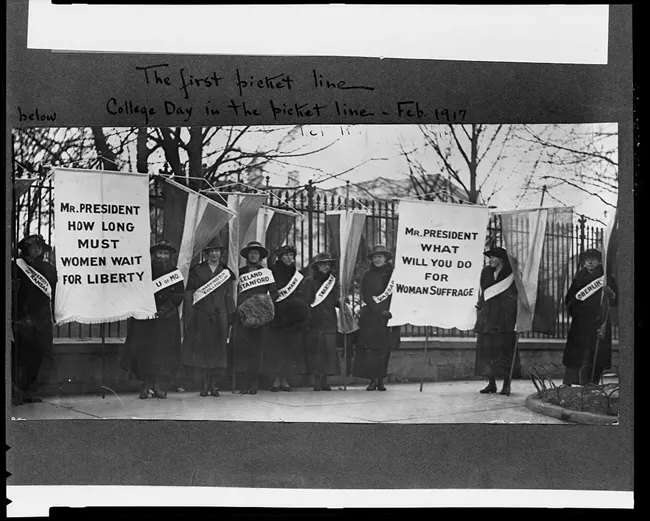
Photo source: Library of Congress
Another powerful moment of the Engage conference came from a history professor who spoke.
As the professor spoke, behind her on the screen was a portrait of Mercy Otis Warren, a woman most of us were not taught about in school. Warren was a playwright, a poet, and a political thinker. She wrote a play called The Adulateur in 1772, which was a sharp satirical critique of colonial power, published and circulated when women had no formal political voice whatsoever.
Next to her portrait was the play’s program cover. Then came a photograph, black and white, of women standing outside the White House gates. Their signs read: Mr. President, How Long Must Women Wait for Liberty? and Mr. President, What Will You Do for Women’s Suffrage?
At the conference, the room was quiet as many of us pondered these women so long ago who knew that they must resist. The suffragettes showed up at the gates, in the pamphlets, in the plays, in the rooms where decisions were being made about them, but without their vote.
As we assembled in a spectacular building in Washington, D.C., surrounded by women from every sector including healthcare, finance, policy, and business, we were having conversations about economic security, AI, legislation, and leadership. Mercy Otis Warren would have had a lot to say. I think she would be thrilled with the progress that’s been made and at the same time, miffed at some of the backsliding.
We’re not starting from scratch. We’re picking up where someone else left off. And somewhere down the line, someone will pick up where we do.
That’s not a small thing. That’s a tradition worth honoring and continuing.




0 Comments